Which Family of Elements Does Not Readily Form Ions?
Learning Objectives
Past the end of this section, you will exist able to:
- Define ionic and molecular (covalent) compounds
- Predict the blazon of chemical compound formed from elements based on their location within the periodic table
In ordinary chemical reactions, the nucleus of each cantlet (and thus the identity of the element) remains unchanged. Electrons, however, can be added to atoms by transfer from other atoms, lost past transfer to other atoms, or shared with other atoms. The transfer and sharing of electrons amidst atoms govern the chemistry of the elements. During the formation of some compounds, atoms gain or lose electrons, and form electrically charged particles called ions (Figure 1).
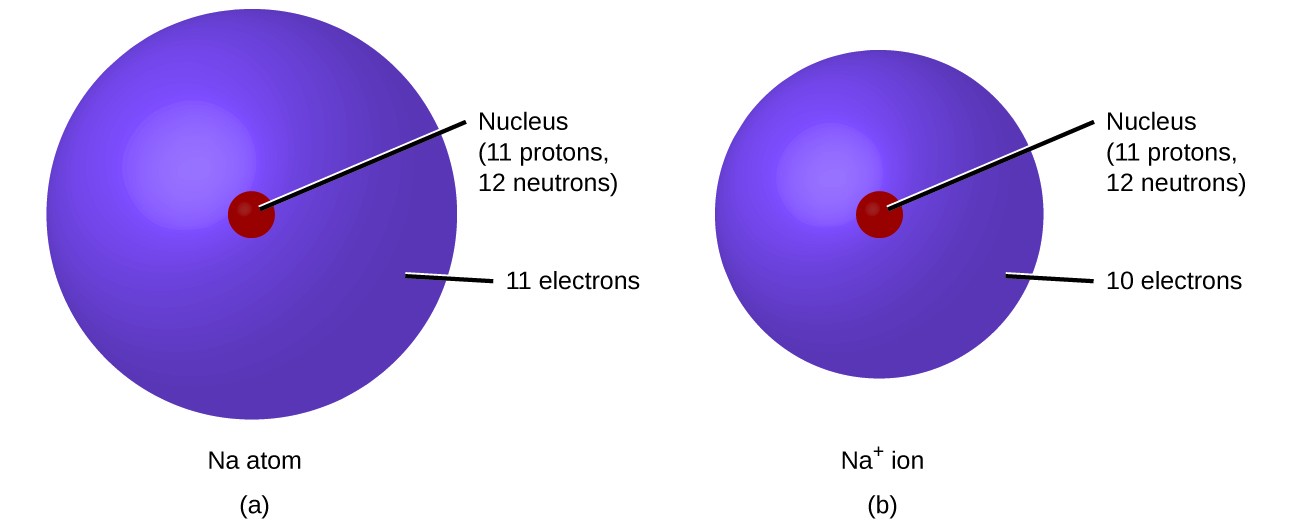
Effigy i. (a) A sodium cantlet (Na) has equal numbers of protons and electrons (xi) and is uncharged. (b) A sodium cation (Na+) has lost an electron, so it has i more proton (eleven) than electrons (10), giving it an overall positive charge, signified by a superscripted plus sign.
You can utilize the periodic table to predict whether an atom will form an anion or a cation, and yous can often predict the charge of the resulting ion. Atoms of many main-grouping metals lose enough electrons to leave them with the same number of electrons as an atom of the preceding noble gas. To illustrate, an atom of an alkali metal (group i) loses one electron and forms a cation with a 1+ accuse; an element of group ii (group 2) loses two electrons and forms a cation with a 2+ charge, and and so on. For example, a neutral calcium atom, with 20 protons and 20 electrons, readily loses 2 electrons. This results in a cation with 20 protons, 18 electrons, and a 2+ charge. Information technology has the aforementioned number of electrons as atoms of the preceding noble gas, argon, and is symbolized Catwo+. The name of a metal ion is the same as the name of the metal atom from which it forms, then Ca2+ is called a calcium ion.
When atoms of nonmetal elements form ions, they generally gain plenty electrons to give them the aforementioned number of electrons as an atom of the side by side noble gas in the periodic table. Atoms of group 17 gain one electron and form anions with a one− charge; atoms of grouping 16 gain two electrons and form ions with a 2− charge, so on. For instance, the neutral bromine cantlet, with 35 protons and 35 electrons, can gain one electron to provide it with 36 electrons. This results in an anion with 35 protons, 36 electrons, and a 1− charge. Information technology has the same number of electrons equally atoms of the adjacent noble gas, krypton, and is symbolized Br−. (A discussion of the theory supporting the favored status of noble gas electron numbers reflected in these predictive rules for ion germination is provided in a later affiliate of this text.)
Annotation the usefulness of the periodic table in predicting probable ion formation and accuse (Effigy two). Moving from the far left to the right on the periodic table, principal-group elements tend to form cations with a charge equal to the group number. That is, group 1 elements form i+ ions; group ii elements grade 2+ ions, and so on. Moving from the far right to the left on the periodic table, elements oftentimes form anions with a negative accuse equal to the number of groups moved left from the noble gases. For example, group 17 elements (one grouping left of the noble gases) form 1− ions; group 16 elements (two groups left) class ii− ions, and and then on. This trend tin can exist used as a guide in many cases, but its predictive value decreases when moving toward the center of the periodic table. In fact, transition metals and another metals often showroom variable charges that are not predictable past their location in the table. For case, copper can form ions with a 1+ or 2+ charge, and iron can course ions with a 2+ or 3+ charge.
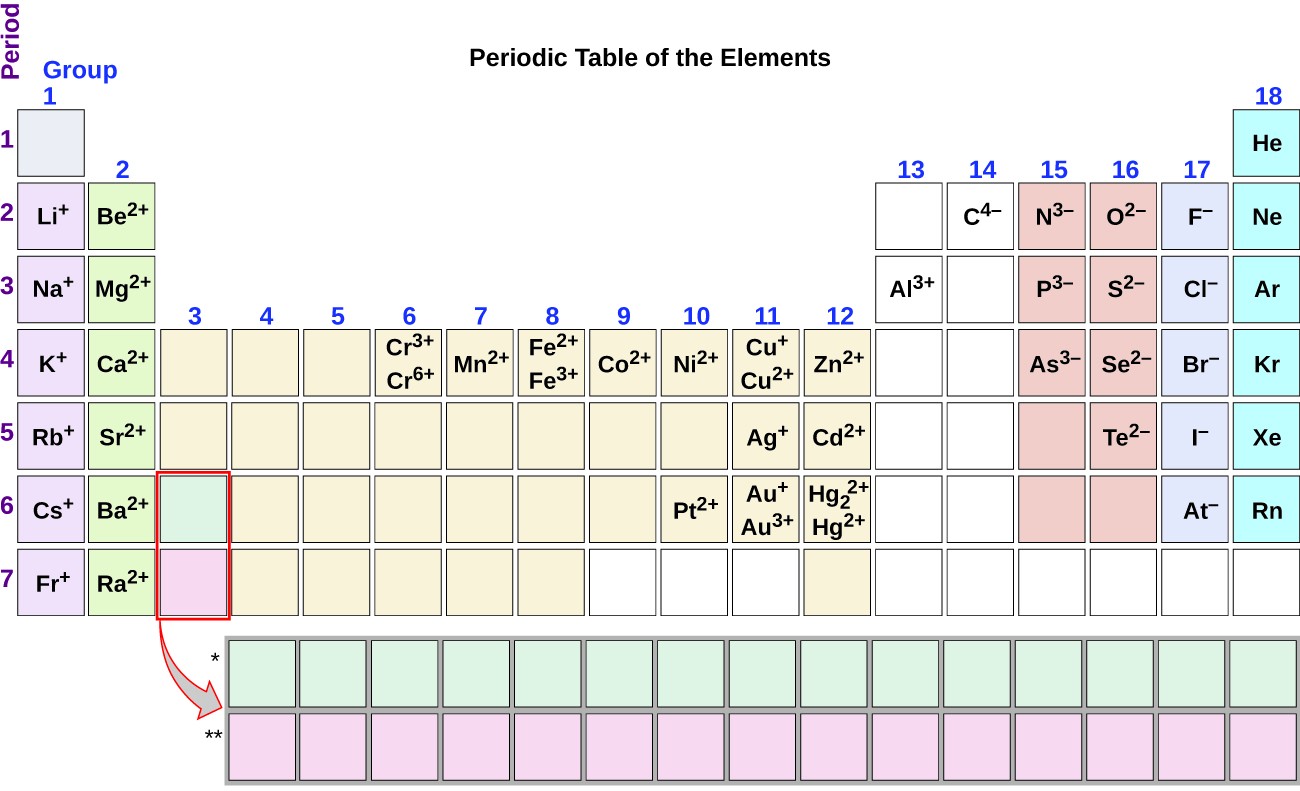
Figure 2. Some elements exhibit a regular pattern of ionic accuse when they form ions.
Example 1: Limerick of Ions
An ion institute in some compounds used as antiperspirants contains xiii protons and 10 electrons. What is its symbol?
Prove Respond
Because the number of protons remains unchanged when an cantlet forms an ion, the atomic number of the element must be 13. Knowing this lets us use the periodic table to place the chemical element as Al (aluminum). The Al atom has lost three electrons and thus has three more positive charges (13) than information technology has electrons (x). This is the aluminum cation, Al3+.
Cheque Your Learning
Give the symbol and name for the ion with 34 protons and 36 electrons.
Prove Answer
Setwo−, the selenide ion
Case 2: Formation of Ions
Magnesium and nitrogen react to form an ionic compound. Predict which forms an anion, which forms a cation, and the charges of each ion. Write the symbol for each ion and proper noun them.
Check Your Learning
Aluminum and carbon react to form an ionic compound. Predict which forms an anion, which forms a cation, and the charges of each ion. Write the symbol for each ion and name them.
Evidence Answer
Al will class a cation with a accuse of 3+: Al3+, an aluminum ion. Carbon will course an anion with a charge of four−: C4−, a carbide ion.
The nature of the bonny forces that concord atoms or ions together inside a compound is the basis for classifying chemical bonding. When electrons are transferred and ions course, ionic bonds result. Ionic bonds are electrostatic forces of attraction, that is, the attractive forces experienced betwixt objects of opposite electric accuse (in this example, cations and anions). When electrons are "shared" and molecules grade, covalent bonds consequence. Covalent bonds are the attractive forces between the positively charged nuclei of the bonded atoms and i or more pairs of electrons that are located between the atoms. Compounds are classified equally ionic or molecular (covalent) on the basis of the bonds present in them.
Ionic Compounds
When an element composed of atoms that readily lose electrons (a metal) reacts with an element composed of atoms that readily proceeds electrons (a nonmetal), a transfer of electrons usually occurs, producing ions. The compound formed by this transfer is stabilized by the electrostatic attractions (ionic bonds) betwixt the ions of contrary accuse present in the chemical compound. For example, when each sodium atom in a sample of sodium metal (grouping 1) gives up one electron to form a sodium cation, Na+, and each chlorine atom in a sample of chlorine gas (group 17) accepts one electron to form a chloride anion, Cl−, the resulting compound, NaCl, is composed of sodium ions and chloride ions in the ratio of ane Na+ ion for each Cl− ion. Similarly, each calcium atom (group 2) tin surrender two electrons and transfer one to each of two chlorine atoms to course CaCl2, which is composed of Ca2+ and Cl− ions in the ratio of one Ca2+ ion to ii Cl− ions.
A compound that contains ions and is held together by ionic bonds is called an ionic compound. The periodic tabular array can help the states recognize many of the compounds that are ionic: When a metal is combined with one or more nonmetals, the compound is normally ionic. This guideline works well for predicting ionic compound germination for most of the compounds typically encountered in an introductory chemistry course. However, information technology is non ever true (for example, aluminum chloride, AlCliii, is not ionic).
You can frequently recognize ionic compounds because of their backdrop. Ionic compounds are solids that typically melt at high temperatures and boil at fifty-fifty higher temperatures. For example, sodium chloride melts at 801 °C and boils at 1413 °C. (As a comparison, the molecular compound water melts at 0 °C and boils at 100 °C.) In solid course, an ionic compound is not electrically conductive because its ions are unable to menstruum ("electricity" is the menses of charged particles). When molten, however, information technology can conduct electricity because its ions are able to move freely through the liquid (Figure 3).
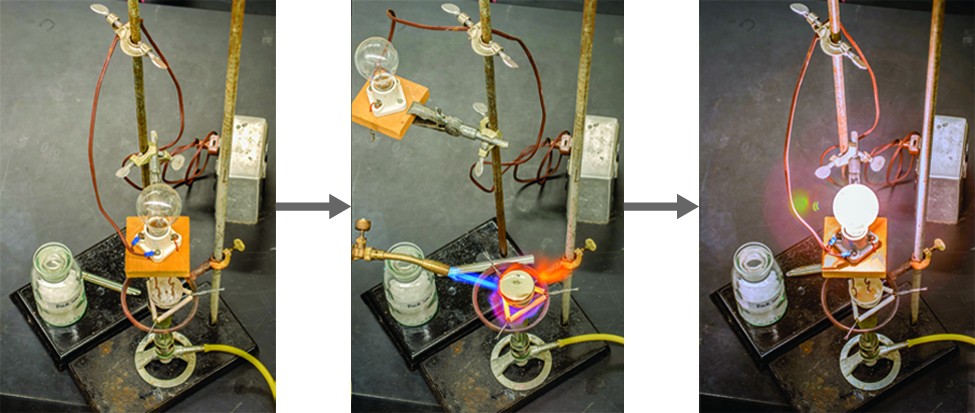
Figure 3. Sodium chloride melts at 801 °C and conducts electricity when molten. (credit: modification of work past Mark Blaser and Matt Evans)
Lookout man this video to run into a mixture of salts cook and conduct electricity.
Molecular Compounds
Many compounds do not incorporate ions simply instead consist solely of discrete, neutral molecules. These molecular compounds (covalent compounds) result when atoms share, rather than transfer (gain or lose), electrons. Covalent bonding is an important and extensive concept in chemistry, and information technology will be treated in considerable detail in a later affiliate of this text. Nosotros tin frequently identify molecular compounds on the basis of their physical backdrop. Under normal conditions, molecular compounds oftentimes be as gases, depression-boiling liquids, and low-melting solids, although many important exceptions exist.
Whereas ionic compounds are usually formed when a metal and a nonmetal combine, covalent compounds are usually formed past a combination of nonmetals. Thus, the periodic table tin can assist us recognize many of the compounds that are covalent. While we can utilise the positions of a compound's elements in the periodic table to predict whether information technology is ionic or covalent at this betoken in our study of chemistry, you should exist enlightened that this is a very simplistic approach that does non account for a number of interesting exceptions. Shades of greyness exist between ionic and molecular compounds, and you'll learn more near those later.
Example 5: Predicting the Type of Bonding in Compounds
Predict whether the following compounds are ionic or molecular:
- KI, the compound used as a source of iodine in table salt
- H2O2, the bleach and disinfectant hydrogen peroxide
- CHCl3, the coldhearted chloroform
- Li2CO3, a source of lithium in antidepressants
Cheque Your Learning
Using the periodic table, predict whether the following compounds are ionic or covalent:
- SO2
- CaF2
- NiiH4
- Altwo(SO4)3
Key Concepts and Summary
Metals (particularly those in groups ane and 2) tend to lose the number of electrons that would leave them with the aforementioned number of electrons as in the preceding noble gas in the periodic tabular array. By this means, a positively charged ion is formed. Similarly, nonmetals (particularly those in groups 16 and 17, and, to a lesser extent, those in Grouping fifteen) tin can gain the number of electrons needed to provide atoms with the aforementioned number of electrons as in the next noble gas in the periodic table. Thus, nonmetals tend to class negative ions. Positively charged ions are chosen cations, and negatively charge ions are chosen anions. Ions can be either monatomic (containing just one atom) or polyatomic (containing more than one atom).
Compounds that contain ions are called ionic compounds. Ionic compounds more often than not form from metals and nonmetals. Compounds that exercise not incorporate ions, but instead consist of atoms bonded tightly together in molecules (uncharged groups of atoms that behave equally a single unit), are called covalent compounds. Covalent compounds usually form from two nonmetals.
Exercises
- Using the periodic table, predict whether the post-obit chlorides are ionic or covalent: KCl, NCl3, ICl, MgCl2, PClfive, and CClfour.
- Using the periodic table, predict whether the following chlorides are ionic or covalent: SiClfour, PClthree, CaCl2, CsCl, CuCl2, and CrClthree.
- For each of the following compounds, state whether it is ionic or covalent. If it is ionic, write the symbols for the ions involved:
- NFiii
- BaO,
- (NH4)2COiii
- Sr(H2PO4)2
- IBr
- NaiiO
- For each of the following compounds, country whether it is ionic or covalent, and if it is ionic, write the symbols for the ions involved:
- KClOiv
- MgCiiH3Otwo
- H2S
- AgtwoS
- Northward2Cl4
- Co(NO3)two
Glossary
covalent bond: bonny strength between the nuclei of a molecule's atoms and pairs of electrons between the atoms
covalent compound: (as well, molecular compound) composed of molecules formed by atoms of two or more different elements
ionic bond: electrostatic forces of allure between the oppositely charged ions of an ionic compound
ionic chemical compound: compound composed of cations and anions combined in ratios, yielding an electrically neutral substance
molecular compound: (also, covalent compound) composed of molecules formed past atoms of ii or more than different elements
monatomic ion: ion composed of a unmarried atom
Source: https://courses.lumenlearning.com/suny-mcc-introductorychemistry/chapter/ions-and-ionic-compounds/
0 Response to "Which Family of Elements Does Not Readily Form Ions?"
Postar um comentário